
Online Exam Help UK
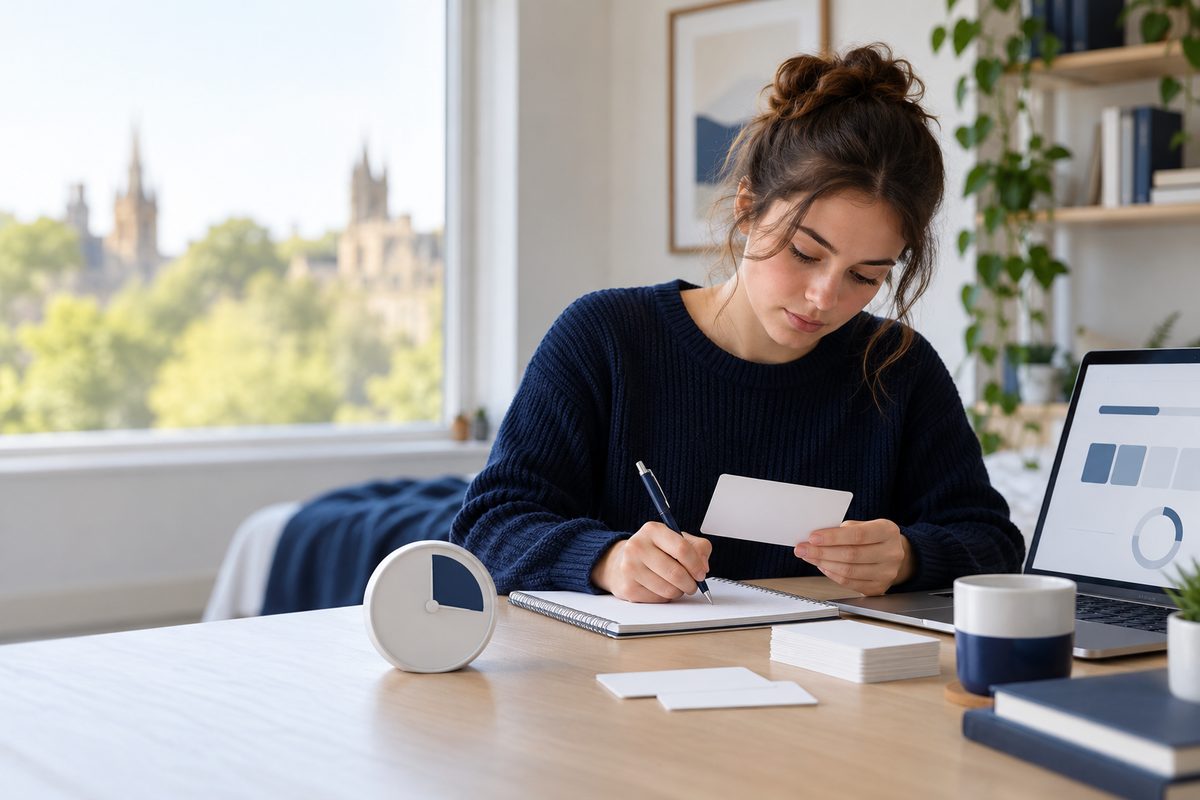
Online exam help from Assignment Mentor prepares you before the exam and never during it. A mentor builds a revision plan around your working week, sets timed practice questions and gives written feedback on your answers. You then sit the paper alone, under your awarding body's rules.
Pricing
Pick the support you need and your exam date to see a price before you commit.
| Service | Typical length | Price | Typical deadline |
|---|---|---|---|
| Revision plan and topic check | Up to 3,000 words | from £9.99 per 100 words | 2–3 working days |
| Timed mock paper with written feedback | Up to 3,000 words | from £9.99 per 100 words | 2–3 working days |
| Open-book or take-home technique session | Up to 3,000 words | from £9.99 per 100 words | 2–3 working days |
Online exam help for working learners
Many of our learners study while holding down a job. Evenings are short, so we plan around them. Support covers:
- Exams set by a professional body and sat from home
- College and university papers sat on a screen
- Open-book and take-home papers on diploma or degree modules
Remote exams set by a professional body
Some professional bodies run timed exams at home with a live invigilator. ACCA is one example. We cannot speak for every body, so send us your candidate handbook and we will plan around its real rules rather than guess them.
Online papers on college and university courses
A department may set a timed paper on screen, an open-book essay or a short quiz. Send the instructions you were given. We use them to plan your practice and to check the length and format you must meet.
What is an online exam
An online exam is any assessment you take on a device instead of in a hall. The format changes from course to course, so read your instructions before you plan anything.
Fixed-time and window formats
In a fixed-time exam you log in, start together and finish at a set time. In a window format you collect the paper and hand in answers any time within the window. Preparation differs: the first tests speed, the second tests planning.
Invigilated and unsupervised papers
Some exams are watched through your webcam. Others rely on your honesty and on later checks. Either way, the paper must be your own work, and your provider's rules about notes and devices apply.
How to prepare for an online exam
Treat the logistics as part of revision. A learner who knows the content can still lose marks to a login problem.
Read the candidate rules first
Write down the start time, length, number of questions, allowed materials and who to contact if something fails. Leeds Beckett's library also suggests checking whether a paper is open book and which equipment you may use. Put every detail in your calendar.
Prepare the room and the kit
ACCA's exam-day page asks for a private, well-lit room, photo ID and a clear desk, and says check-in takes about 10 minutes. Whatever your provider says, test your laptop, camera and connection a few days early, not on the morning.
Rehearse the clock
Newcastle University suggests taking 10 minutes off the start for reading and planning, and about 15 off the end for checking, then dividing the rest by the marks per question. Run one practice paper to that split.
Open book exam tips
Open book rarely means easy. Markers expect you to use ideas on a new problem, not to copy from notes.
- Bring a few pages of concise notes, not a pile of books
- Index your sources and mark useful pages
- Revise frameworks and evidence, not scripted answers
- Practise applying one idea to a work scenario
Build an index you can search in seconds
Bath's skills team suggests contents pages, bookmarks, margin summaries and index cards listing topics and page numbers. List formulae and definitions on one sheet. If you cannot find a point in under a minute in practice, simplify the system.
Revise to apply, not to recite
Take each topic and ask where it works, where it fails and what a manager would do with it. Bath advises against writing model answers to predicted questions. Your mentor sets fresh scenarios so you practise on questions you have not seen.
Take home exam help
A take-home paper gives you a longer window, so it tests planning and argument. A long window is not a long writing session.
Split the window into stages
Reserve time to read, plan, write, check references and upload. Add sleep and meals. Aim to finish a full draft well before the deadline, then leave a margin for the upload, since late files can fail.
Answer the question set
Use the wording of the question in your opening lines and keep your evidence tied to it. Reference in the style your instructions name, and keep to the stated length. For layout ideas, see report writing structure.
Online exam revision
Revise in short, active sessions and test yourself often. The plan below is invented for illustration. Move the weeks to fit your date.
| Week | Focus | Evening sessions (45 minutes) |
|---|---|---|
| 1 | Map the syllabus | List every topic and rate it weak, fair or strong. |
| 2 | Weak topics | Close the notes and write what you remember, then check. |
| 3 | Weak topics again | Answer two short questions per topic and mark them against the criteria. |
| 4 | Timed practice | One full timed paper, with feedback from your mentor. |
| 5 | Fix the gaps | Rework the lowest-scoring answers and test your set-up. |
| 6 | Light review | Short recall sessions, check logistics, rest the night before. |
Fit revision around shifts and family
Short, regular sessions beat one long weekend. Pin the same slots to your calendar each week and protect them. If a week goes wrong, drop the lowest-value topic rather than skipping practice papers.
Use past papers and the specification
Ask your tutor or provider for sample papers. Check each answer against the learning outcomes and marking criteria. Our one-way vs two-way ANOVA guide helps if statistics is on your paper.
How it works
- Send your module, exam date and format
- Share the candidate handbook, specification or a sample paper
- Agree a plan: revision, a timed mock or technique
- Answer practice questions and read your written feedback
- Sit the exam yourself, following the rules
Full details are on our how it works page.
Before the exam, never during it
We do not sit exams, supply answers or offer help while a paper is open. All support ends before you start. Read our academic integrity policy.
The day before: a short checklist
- Photo ID ready, if the exam is invigilated
- Desk cleared of anything the rules do not allow
- Other programs closed and the device charged
- Support contact saved where you can reach it
- Start time checked in your own time zone
Related help
- Professional qualifications: CIPD assignment help and CMI assignment help
- Vocational diplomas: OTHM assignment help and HND assignment help
- Short on time? last minute assignment help
Meet our specialists
Nadia Farooq (CIPD Level 5; MSc Human Resource Management): Nadia supports learners with HR qualifications, reflective assignments and practical workplace examples. Her approach focuses on clear structure, relevant evidence and professional tone. George Whitaker (HND Business; BTEC Level 5 Diploma): George helps vocational learners interpret assessment criteria, organise evidence and connect coursework to workplace practice. He aims to make complex instructions straightforward and actionable. Confirm profile details and written consent before publishing.
Get a free quote
Tell us your module, exam date and format. Attach your handbook or a sample paper if you have one.
Sources
- ACCA, Remote exams: on exam day
- Leeds Beckett University Library, Exams and timed assessments
- University of Bath, Top tips for taking open book exams: preparation
- Newcastle University, Academic Skills Kit: exam technique
Frequently asked questions
How do I prepare for an online exam?
Learn the format and rules, test your kit early, revise actively and complete at least one timed practice paper. Rehearse saving and uploading too. A mentor can set the practice and mark it.
What is a take-home exam?
A paper you complete away from the hall within a set window, from a few hours to several days. It rewards planning and clear argument more than memory.
Are online exams open book?
Some are and some are not. Your instructions say which. If notes are allowed, they usually must be your own, and questions tend to test application.
Can you help me during my exam?
No. Our help ends before the paper opens. Outside help during a live exam breaks most providers' rules.
What will I receive?
A revision plan, practice questions with written feedback and a technique session if you want one. You do all the exam work yourself.
How much does online exam help cost?
The price depends on the support, your level and your exam date. Use the calculator above to see it first. Prices start from £9.99 per 100 words for undergraduate work, rising to £17.99 per 100 words at PhD level.
How soon before my exam should I start?
Four to six weeks gives room for a plan and a timed mock. Less is still workable. Send your date and we will say what fits. We aim to reply to every enquiry within 24 hours and confirm the delivery time for your brief once we have seen it.
Can you promise a pass or a grade?
No. Nobody can. We help you practise and show you how to improve your own answers.
Is my information confidential?
Yes. We use your details only to match you with a mentor and give feedback, and we do not share them with your provider. Only the specialists and support staff who need your files to help you can see them.
Do you help with professional-body exams?
We help with preparation for many formats. Send your handbook, and we will tell you honestly if the paper is outside our subjects.
Is this allowed by my awarding body or university?
Tutoring and feedback before an exam are common, but rules differ. Check your provider's policy and always sit the exam as yourself.
What if my connection fails during the exam?
Follow your provider's instructions and contact their support at once. Keep their contact details and take screenshots of any error.